The Real Shift: "Google It" Became "Just ChatGPT It"
For years, "just Google it" was the default response to any question. That's not universally true anymore. A growing share of queries now happen inside AI chat tools directly: people ask ChatGPT, Perplexity, or Google's AI Overview the question and get an answer without ever seeing a traditional search results page.
This matters enormously for how businesses need to think about content. Optimizing only for Google rankings means optimizing for half the game. If your content isn't structured to be understood, trusted, and cited by AI systems, you're invisible in a growing share of the conversations happening about your industry, even if you rank on page one of Google.
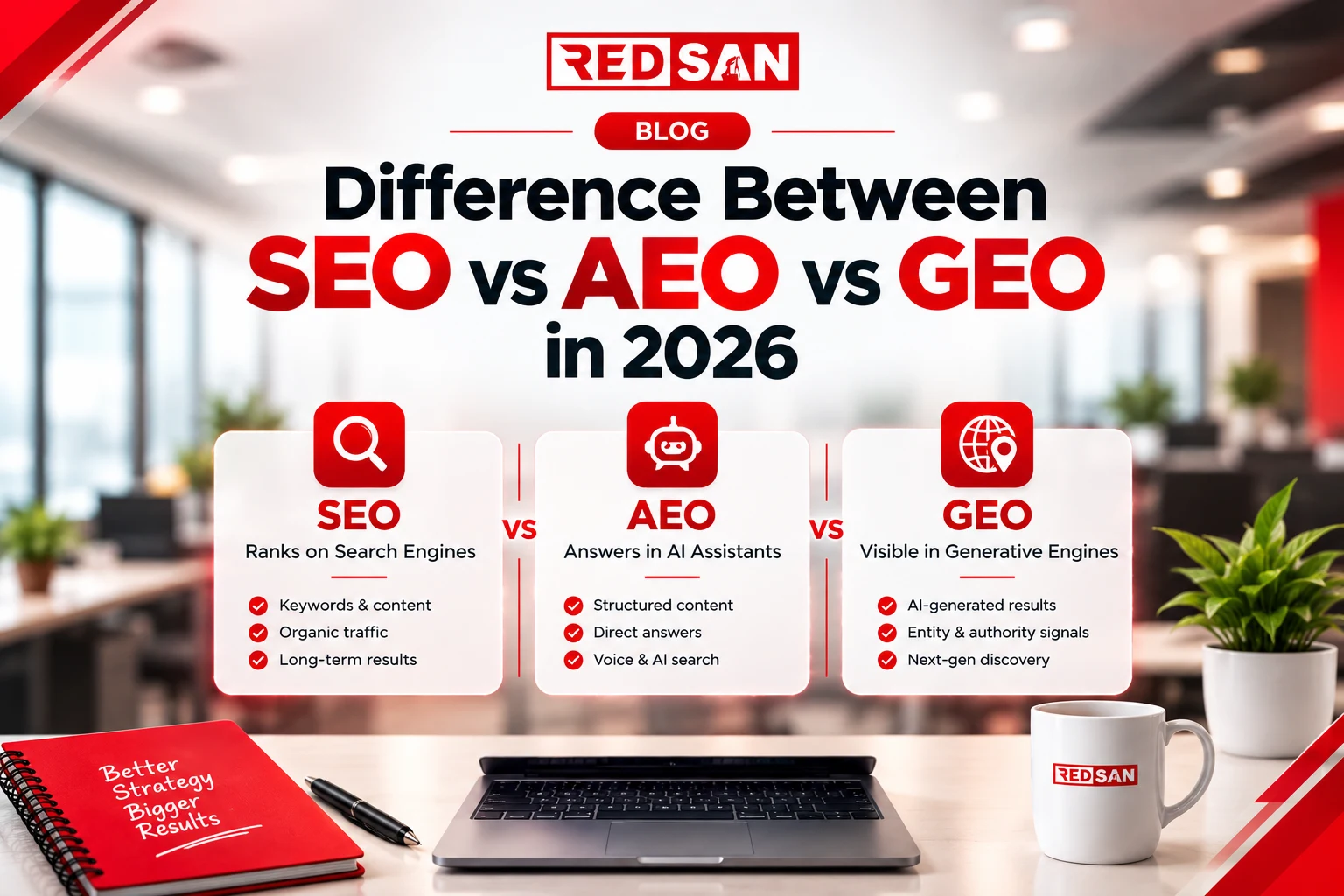
Core Differences: SEO vs AEO vs GEO
| Dimension | SEO | AEO | GEO |
|---|---|---|---|
| Full form | Search Engine Optimization | Answer Engine Optimization | Generative Engine Optimization |
| Primary goal | Rank in search, drive clicks and traffic | Be selected as the direct answer (snippets, voice, AI Overviews) | Be cited and referenced inside AI-generated answers |
| Main surfaces | Google/Bing organic results, Local Pack, Maps | Featured snippets, People Also Ask, voice assistants, AI Overviews | ChatGPT, Perplexity, Claude, Gemini, AI Overviews with citations |
| Key focus | Keywords, backlinks, technical health, content quality | Clear Q&A structure, concise answers, FAQ schema | Machine-readable structure, authoritative content, quotable data, entity signals |
| Success metric | Rankings, organic traffic, conversions | Snippet win rate, AI Overview presence | Citation frequency inside AI answers |
These aren't competing strategies. SEO gets your pages found and trusted in the first place. AEO structures your best pages to be pulled as direct answers. GEO makes sure AI systems see your brand as a credible source worth citing. One well-built page can do all three at once.
Why Technical SEO and Digital PR Still Matter More Than Ever
None of AEO or GEO works without a solid SEO foundation underneath it. AI systems, including the ones powering AEO and GEO surfaces, tend to prefer content that already ranks well and is trusted by traditional search. That means technical SEO (site speed, mobile-friendliness, clean structure, proper indexing) is still the base layer everything else sits on.
The other piece that's become more important, not less: quality digital PR and backlinks. Getting your brand mentioned and linked to from genuinely authoritative sources builds the trust signal both traditional search engines and AI systems use to decide whether your content is worth surfacing or citing. Businesses treating backlinks as a checkbox activity rather than a real reputation-building effort are going to fall further behind as AI-driven search grows.
Parasite SEO: The Tactic Redsan Has Personally Seen Work
One tactic worth understanding here, generally called parasite SEO: instead of relying only on your own website's authority, you publish content on already-authoritative third-party platforms (LinkedIn, industry publications, high-domain-authority sites) that already have the trust signals AI systems and search engines respect.
This isn't theoretical for us. Redsan's founder, P. Sankalp Reddy, has personally seen this work firsthand: consistent, genuinely useful content published directly on LinkedIn has led to that personal brand getting picked up and featured inside LLM-generated answers, essentially riding LinkedIn's existing domain authority to get cited by AI tools faster than a newer or smaller personal website could achieve alone. That's parasite SEO working in practice, not just in a framework diagram.
Proof This Works: How Redsan Builds Its Own Content
We don't just write about this framework, we build our own blog around it. Every post on redsan.in, including our Dehradun website cost breakdown, uses the same structure this article is describing:
- A frontmatter block with meta title, meta description, and sources upfront (the SEO and GEO layer)
- A Quick Answer section near the top, written to be pulled directly as a snippet or AI Overview response (the AEO layer)
- Structured FAQs with schema markup, so search engines and AI tools can extract clean question-and-answer pairs (AEO and GEO working together)
- Real sources and data, clearly cited, because AI systems favor content they can verify and trust (the GEO layer)
If you want proof this isn't just a nice-sounding framework, look at how this exact post, and every other post on our blog, is structured.
Action Checklist: What to Actually Do About This
- Fix the SEO fundamentals first. Site speed, mobile-friendliness, clean indexing. Nothing else works without this.
- Add a direct-answer block to your key pages. A concise 40 to 60 word answer near the top, written the way someone would actually ask the question out loud.
- Implement FAQ schema. Structure questions and answers clearly enough that both Google and AI tools can extract them cleanly.
- Invest in genuine digital PR and backlinks. Not link farms: real mentions from sources with actual authority.
- Consider a parasite SEO play. Publishing consistently on platforms like LinkedIn can get your expertise in front of AI systems faster than waiting for your own domain to build authority from scratch.
- Test yourself. Ask ChatGPT or Perplexity the questions your business should be answering. See who gets cited. If it's not you, that's your roadmap.
Frequently Asked Questions
Q1: Do I need to choose between SEO, AEO, and GEO?
No. They're complementary layers, not competing strategies. A single well-structured, well-sourced page can rank in Google, win a featured snippet, and get cited inside an AI-generated answer, all at once.
Q2: What is parasite SEO, and does it actually work?
Parasite SEO means publishing content on already-authoritative third-party platforms, like LinkedIn, rather than relying solely on your own website's domain authority. Redsan's founder has seen this work directly: consistent LinkedIn content has led to personal brand mentions getting picked up inside LLM-generated answers.
Q3: Why does digital PR matter more now than a few years ago?
Both traditional search engines and AI systems use backlinks and mentions from genuinely authoritative sources as trust signals. As AI-driven search grows, weak or low-quality backlink strategies fall further behind businesses building real digital PR.
Q4: How do I know if my content is actually working for GEO, not just SEO?
Ask the questions your business should answer directly inside ChatGPT, Perplexity, or Google's AI Overview. If your brand isn't showing up as a cited source, your content likely isn't structured for GEO yet, regardless of how well it ranks in traditional search.